
By Jeanine Skowronski
Somewhere, anywhere, everywhere, maybe, there’s this town, my town, our town, and it’s surrounded by old, dead apple orchards, tart, overripe, tarred. And just beyond these dead orchards, there’s a sign, off-white and split down its middle (Wel ome!) and just 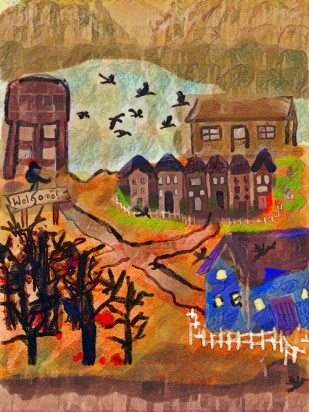 after this sign, before any other houses, there’s one house, an empty house, also humpty-dumptied, sharp and splat, and on this house’s pieces, there are always at least thirteen crows, and, if you follow the crows as they take turns flying in the sky, you’ll see a water tower that, legend has it, was once the loveliest blue of all the blues, but is now brown-red with rust, and, next to this water tower, up on a high hill, there’s another house, big, but not at all beautiful, and this house looks down upon rows and rows and rows of rowhouses, which aren’t rowhouses, really, because they each lean just a bit to the left, close, but not quite touching. And all of these rowhouses have squirrels in their attics and snakes in their basement, and, in three or four or eleven of them, the squirrels and snakes share acorns and mice with one or two ghosts, and between these ghosts and vermin, there are people, of course: a middle-aged man who’s always praying, a youngish man who’s always digging, a ole Mrs. who’s always complaining, usually about someone trying to poison her food (Girl, girl, look! Bits of this bread are blue!); and when someone here gets angry, they get so angry, our teapots whistle, and when someone here cries, they cry so hard, the pipes leak, and none of us, not a one of us, can get our radios to play a happy tune and the mail, if it arrives, arrives in gray envelopes and the air always smells of bad fruit and on and on and on. And on and on, beyond these strange rowhouses, there’s a main street that’s not called Main Street; in this town, it’s called Second Street. And on Second Street, there’s a brown-stoned bar that only serves house wine and whiskey, a butcher shop, a café with just one table, a pain management center, a dentist, and, further down, a school. And in this school, the Simpson sisters whisper about a boy, real, but unreal, who haunts the abandoned 7-11, a beautiful monster boy who, if you’re not good and careful, will steal your soul; and the Donny-boy brothers, real, not unreal, talk loudly about a horrid girl, a devil girl, a dead girl, who, if you’re foolish enough to fall in love, will sneak into your bed and rip out your heart; and all of the kids, they whisper about that big house on the hill and how it must mark, it has to mark, the end of the world, even though, beneath that home (and its hill), there are a few nice houses with 300% less ghosts and 500% more backyard. And just past those houses, finally, there’s the other end of town, which, too, is surrounded by dead apple orchards, and, in this part of the orchards, there are sharp-beaked birds that hiss and deer that spit and fires that sometimes just burn and burn and burn; but if you were to try, maybe, if you were to try, finally, if you were to hop in a thick-tinned car, say, and get through this batch of dead orchards and all its little fires, then, I think, you’d come out on a dirt road, and along that dirt road, eventually, you’d find a proper ramp, and if you found that proper ramp, you could cruise the highway, and if you cruised the highway long enough, maybe, just maybe, you’d find grass that is green and sky that is blue and corn that is fed and, I don’t know, fat cows going moo and, beyond those cows, there’d be another town, a new town, and, in that town, surely, the welcome sign is in one piece, lacquered with all its letters (Welcome!) and the hills aren’t high enough for lonely houses and the mail, instead, is a mountain of invitations and the rain, it never pours. And there, the adults all cut loose, probably, and the kids don’t speak of monsters, maybe, because nothing is haunted or gnarled, and the living things — only the living things, of course — sit together at café tables, eat pie, touch hands, and warm their faces, never hunger, never burn.
Jeanine Skowronski is a writer based in N.J. Her work has appeared in X-R-A-Y Lit, Lost Balloon, Five on the Fifth, (mac)ro(mic), Complete Sentence, Crow & Cross Keys, and Tiny Molecules. She placed 2nd in Reflex Fiction’s 2021 Winter Flash Fiction competition.
 MoonPark Review