
By J. D. Strunk
The company was nearly asleep as it marched, two abreast, away from fields of death. The disheveled men were imprinted with decay; it seeped into their clothes, into their skin, into the very cells of their war-thinned bodies. Some of the men were missing pieces of those bodies; limbs which had seemed so immutable before the war had proved terrifyingly pliant. All present had been changed by the war—none for the better.
They trod on.
After many hours they arrived at an abandoned trench, and it was decided that they would shelter within for the night. The men descended into the frozen labyrinth of bloodstained walls, collapsed onto earthen floors dusted with splintered bone.
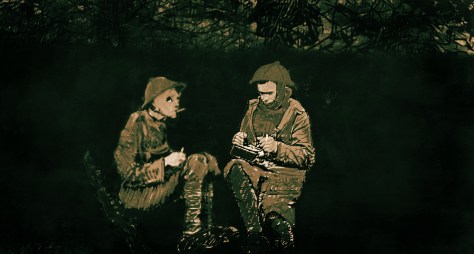 A boy of sixteen climbed into the trench. After removing his pack, he slid down the wall to the frozen ground. A second boy, older but not by much, sat down next to him. For a time, neither said a word. Both tried to sleep. Neither succeeded.
“You were asking about Marne…” said the older boy abruptly.
“I wasn’t,” said the younger boy.
“This morning. You asked about the battle.”
“I didn’t.”
“Was that not you?”
“No.”
“Well, no matter—it’s a story worth hearing.”
“I’m too tired to think,” said the younger boy. “I don’t want a story.”
With effort, the younger boy pulled an alabaster hand from the sleeve of his muddied uniform. Stiff fingers pawed at the button of his left breast pocket—the action almost comical in its inefficacy—before finally managing to undo the flap and reach inside. Frostbitten fingertips removed a pack of cigarettes.
“Yes, you do,” said the older boy. “Never turn down a story.”
The younger boy offered a cigarette to the older boy, who accepted. “Why?” asked the younger boy.
“If you’re telling a story, or hearing one being told,” said the older boy, feeling his own pockets for matches, “it means you’re still alive.”
The older boy found his matches. He placed the matchhead against the box, took a deep breath, and moved it quickly forward. The flame erupted easily, and the older boy moved his cupped hand, slowly, to the cigarette of the younger boy. Just before the flame died, the older boy lit his own.
The younger boy inhaled on his cigarette, closed his eyes. “What’s it about?” he asked. “Your story?”
“Glory and éclat,” said the older boy, releasing a cloud of smoke above him.
“What else?”
“Heartbreaking bravery.”
“What else?”
“Loose women and opium dens.”
The younger boy opened his eyes. “Go on, then,” he said.
The storyteller nodded, but hesitated, as if collecting himself—as if he was about to speak before a crowd of thousands, and not one person.
“Thing is,” said the older boy, by way of digression, “the lad who told me this story didn’t survive but five minutes after finishing it. Shot through the heart by friendly fire. Dumb luck. But what really stuck me was that, if he had died even an hour earlier, his story would’ve died with him. And now I reckon I’m the only one in the entire world who knows it.” The older boy looked toward the younger boy and smiled. “But soon you’ll know it too.”
In the near distance there was a sudden explosion, followed by a rainfall of dirt into the trench. Following the blast, the older boy held up a finger, appealing for silence. Sure enough, a whistling, and then another explosion, this one closer—so close that the trenches shook with the impact. And then, seconds later, another explosion, closer still.
Then another, even closer, even louder.
J.D. Strunk was born in Boston, Massachusetts, grew up in northern Ohio, and is currently a copy editor in Denver, Colorado. He has a degree in English Literature from the University of Toledo. His fiction has appeared or is forthcoming in The Louisville Review, The Bookends Review, Allium: A Journal of Poetry & Prose, Jimson Weed, New Plains Review, and elsewhere. He was a finalist for The Bellingham Review Tobias Wolff Award for Fiction.
 MoonPark Review