
By Matt Leibel
The octopus correctly predicts the winner of the Super Bowl. The octopus correctly predicts the winner of the presidential election. The octopus correctly predicts the winners of the Oscars—not just Best Picture and Best Actress, but also the technical categories awarded before the telecast at a separate taped ceremony.
The octopus is shown a picture of a deck of playing cards. He is able to determine which card an observer has pulled from the deck with the accuracy and aplomb of an accomplished stage magician. The octopus is unable to hear the oohs and aahs of the crowd through the soundless see-through prison of his tank.
The octopus is featured as a guest weather creature for a week at KMOV Channel 4 in St. Louis, Missouri. He is able to deliver flawless forecasts daily, even during a complicated period of late summer heat and wind, and hail the size of pufferfish. Following the octopus’ successful meteorological run, the regular weatherman at the station suddenly quits his job in disgust, and later vanishes, under mysterious circumstances, deep in the Australian outback.
Adulation for the octopus’ feats of divination bleed over, in certain circles, to accusations of idolatry and witchcraft. The Pope issues an encyclical condemning the handlers and the sponsors of the octopus for their exploitation his gift, all while secretly (and sinfully) imagining the clairvoyant cephalopod on a plate, quick-grilled with just a touch of oil and salt, plus a squeeze of lime.
The octopus’ prognostications are not always perfect, but his rare missteps serve only to make his accomplishments seem more plausible, precluding the possibility that the public are being played for suckers.
The octopus is enlisted by TMZ to predict how long Taylor Swift’s latest relationship will last. The octopus is enlisted to predict how long Pete Davidson’s latest relationship will last. He is enlisted to predict whether a future relationship between Swift and Davidson is in the cards. Rumors swirl, however outlandish, about the octopus’ own personal life—though really, who is he likely to meet, held alone in a watery cage, watched over by researchers 24-7, choosing Nobel Prize winners with his tentacles?
The octopus correctly predicts, to the hour, a major earthquake in Santiago, Chile. By unwittingly serving as an advance warning system, the octopus saves an estimated thousands of lives.
The octopus correctly predicts, to the day, hour, and minute, the exact moment of his own death.
For the precision of his predictions, social media posthumously dubs him “Clocktopus.”
We are not the same in his absence. We are saddened, and maybe a little bit destroyed. But life moves on, and attention is fickle.
The octopus is soon replaced, in the public imagination, by an elephant who uses her trunk to paint flowers in such photorealistic detail that the paintings merge seamlessly with the surrounding landscape her easel is placed in.
One day, I stand in line for hours to watch the pastoral pachyderm painter do her thing.
Fascinated, I step right through the canvass and find myself in a magical garden.
This is where you and I meet—and buoyed by our sylvan surroundings, fall instantly in love.
We look around at the creatures of the garden, wondering which of them possesses the secret ability to gauge our future happiness together.
We slowly approach a jittery rabbit, who resists the instinct to hop away.
We ask the bunny if there is any hope for us, as a couple.
He says, “Do you want me to tell you the truth, or what you want to hear?”
We look at each other and say in unison, “the latter.”
We choose to believe the rabbit when he tells us we will be together forever.
We hold hands and run through the flower garden until we come to the edge of a forest.
We sprint through the forest until we come to the edge of a cliff.
We take deep breaths, dive off the side of the cliff, and plunge into the ocean.
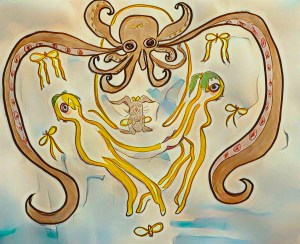
Beneath the surface, we feel ourselves softening, our bones turning to jelly, our arms and legs doubling up.
Our skeletons fall away, and we are more comfortable in our bodies than we’ve ever been on land.
We’re neither worried about the future nor stuck on the past; we’re just floating in the froth of a happy present.
We stare into each other’s monstrous, tennis-ball-sized eyes and ask in unison: “Who could have predicted this?”
Matt Leibel lives in San Francisco. His short fiction has appeared in Electric Literature, Portland Review, Passages North, Quarterly West, Wigleaf, DIAGRAM, and Aquifer: The Florida Review Online. He has been nominated for a Pushcart Prize and included in the anthology Best Small Fictions 2020. Find him on twitter at @matt_leibel.
 MoonPark Review