
By Paul Juhasz
About an hour into her party, Clara Gyorgyey asked me to go for a ride. I made a move toward the driveway. She stopped me, said in her heavy-accent, “No, this way” and walked toward the backyard, toward the pond. There was a rickey, oft-repaired landing, a boat, two patient oars within verdigried locks.
She taught at Yale before “stepping down” to North Haven High School. This was my second year in her English class. She thought we could handle reading Mann’s The Magic Mountain, Kundera’s The Unbearable Lightness of Being. She gave me a nickname. “Little Shepherd.” “What your name means in Hungarian,” she explained. I didn’t like it, then.
“Where are we going?” I asked.
“Just row,” she said.
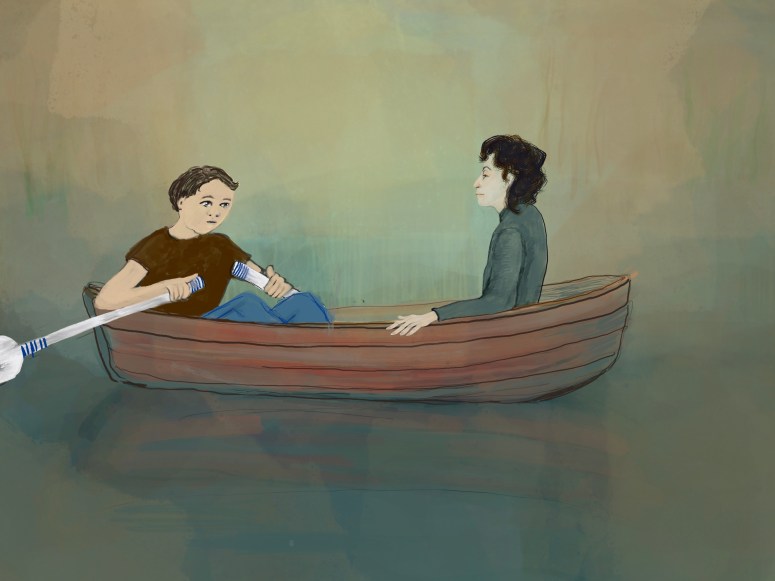 So I rowed. I learned how hard it was to row. My rowing was haphazard, erratic. A curlicue path circling back on itself, going nowhere. Movies make it look so easy, so intuitive. Like riding a bike, without the bike part. I mentioned this.
“You’ll figure it out,” she said.
This close, I learned that even in the bright Connecticut summer sun, pond water stays murky. This close, I learned her wild, unkempt hair—low hanging fruit for adolescent jokes (only when there was no chance of being overheard, for we were all secretly terrified of her)—was a style choice. A patina, like the verdigris.
She died in 2010. Her obituary mentions that since 1972, she was part of the selection committee for the Nobel Prize in Literature. It says nothing about why she left Yale to teach high school kids. In the boat, I mentioned I didn’t understand The Unbearable Lightness of Being. Understood The Magic Mountain even less.
“You’ll figure it out,” she said.
She asked if I liked Hamlet better now. I lied and said I did. When we read it in class, I subverted her assignment—to memorize a passage of dialogue from a character, to be recited whenever called upon—by choosing the tertiary (and even that is being kind) character Bernardo’s “Who’s there?” that opens the play. I thought I was funny. The class clown. She was not amused. I learned the limits of a joke, that there are stains it cannot gild.
In the boat, I apologized for this. She waved the apology away. “Just row” she said.
She then told me of Budapest. Of the Revolution in ‘56. She was twenty-three. She saw her uncle put up against a wall and shot by Russians. She had to flee. She had no time to flee. She left with whatever she could carry and not one thing more. One of those things was Hamlet. Three separate times on her haphazard, erratic flight towards Austria, she was stopped by Russian soldiers. And raped. Three separate times.
“The shame,” she said. “I wanted to die,” she said. “Each and every night,” she said.
Suicide seduced, and she listened. But then she would read Hamlet. His famous soliloquy. Act III, scene 1. And she figured it out. When we read Hamlet in class, I subverted her assignment by choosing Bernardo’s “Who’s there?” I thought I was funny.
I also thought I had hidden things. The fractured kaleidoscope days of beatings, scissor blades, wire brushes, and finger insertions (but only up to the second knuckle). She understood trauma. She invited me into the boat. She told me to row.
She died in 2010. Ten years before my first book. She never read a single poem I wrote. She read every poem I wrote. And every one I have yet to write.
Two years ago, when suicide seduced, I listened. And later, when I thought to improve upon a first failed attempt, she became Hamlet. On the pond, in the boat, she spoke of Budapest. Of the Revolution of ’56. She didn’t know when the story would be needed, just that it would.
She understood trauma. She told me to row.
Paul Juhasz is a Pushcart nominated author of five books: Fulfillment: Diary of a Warehouse Picker, a mock journal chronicling his seven-month term as a Picker at an Amazon Fulfillment Center; As If Place Matters, a collection of short fiction; and three collections of poetry: Ronin: Mostly Prose Poems, a finalist for the 2022 Oklahoma Book Award, The Inner Life of Comics, and The Fires of Heraclitus. He currently lives in Oklahoma City.
 MoonPark Review