By Emily Rinkema
My friend Lila’s heart broke so I gave her mine and now, two weeks later, I wait for her to visit, watching the trams go by my window and ignoring my mother who walks in and out of the room like she keeps forgetting to tell me something.
“Stupid,” she tells me this time, “Stupid.” She picks a hoodie up off the floor, folds it, sets it on my dresser, walks out.
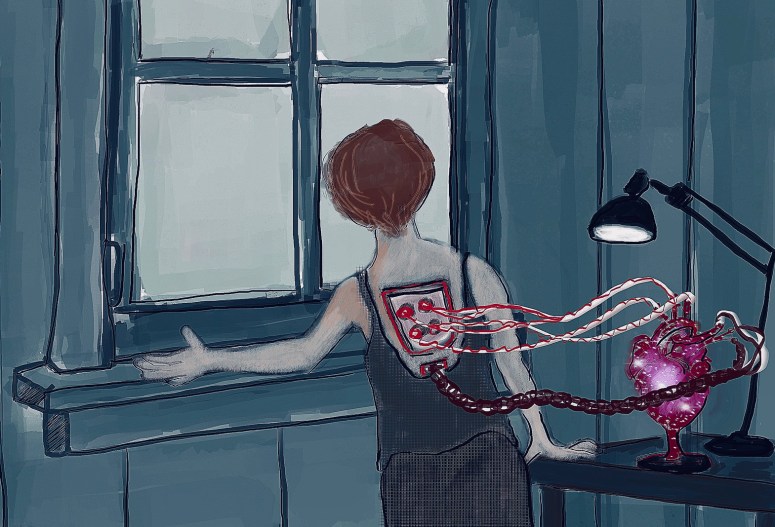 I’m plugged into an external synth-heart on the nightstand, a cheap model that has rebooted at least a dozen times since I came home from Tent Alley. The reboots hurt. Sometimes I can feel them coming on, but other times they slam into me like a tram and I wake up with Mom by my side crying. This morning I heard her on her earphone begging the council for a replacement, but I know it’s a longshot. I’m not eligible for an adult heart until I’m 18, and because of the virus, there’s a shortage of juvenile models. I’ve been through four already since my bio-heart failed when I was six in the First Pandemic, the one that killed my brothers, that made my father leave. And the last heart she got me, the one I came home without because I didn’t understand, because I had no damned idea what the world was like, because I was duped, had been a good one, a strong one, one that she had to make Sacrifices for, that she had Paid Dearly For.
But she’s the one who doesn’t understand. Lila smells like vanilla and limes. She has one blue eye and one brown eye. She has three brothers and two sisters and a cat. She sings when it’s raining out and makes me want to sing too.
When I woke up in my room after coming home from Tent Alley, Mom had been sitting at my bedside, her head on the mattress next to me. I had a fever, the chills. I had been asleep for days. My chest ached from where my heart had been removed, the heart that had been placed in Lila’s chest after we handed over forged permits that the doctors didn’t even look at.
“She’s not even nice to you,” she had said, brushing my hair off my face. Hair that was dark like my father’s.
“She gave me her hoodie,” I said. Only that wasn’t exactly true. She had left it on the tram and I had slipped in my bag.
“You deserve friends who are nice to you,” she said, “Ones who care about you.”
Mom comes back into my room with saline and fresh bandages. She washes out the opening where a tube enters my chest, as she has been doing for days. She knows it stings, but she doesn’t stop. I stare out the window.
“She’s not going to come,” she says to me. And then more quietly, “I’m not trying to hurt you.”
“Just leave me alone,” I say.
Mom caps the bottle and cleans up the side table. She stops at the door for a second, leans against the frame, but decides not to say whatever she was thinking of saying. I hear her go downstairs.
I know she wants me to be sorry. She wants me to say I wish I hadn’t so willingly offered up my heart, the best juvenile model on the market, a heart that had only been in my chest since the last one gave out less than a year ago. She wants me to promise I won’t do anything stupid ever again, that I won’t be so careless, that I won’t leave her.
I hear a tram slowing outside, but it’s just our neighbor who gets off.
I’m sure Lila will be on the next one. I bet she’s getting ready now. Maybe her mom is making something for her to bring and then she’ll hug her and laugh, because I bet her mom laughs all the time, and then she’ll push her out the door and tell her to be good, but she’ll wink and say something like, “But promise you won’t be too good.” And Lila will put her hand over my heart and say something like, “I promise.”
Emily Rinkema lives and writes in northern Vermont, USA. Her writing has recently appeared in The Sun Magazine, SmokeLong Quarterly, and X-R-A-Y Lit, and she has stories in the Best American Nonrequired Reading, Bath Flash, and Oxford Flash anthologies. You can read her work on her website (https://emilyrinkema.wixsite.com/my-site) or follow her on X or IG (@emilyrinkema).
 MoonPark Review