
By Kim Magowan
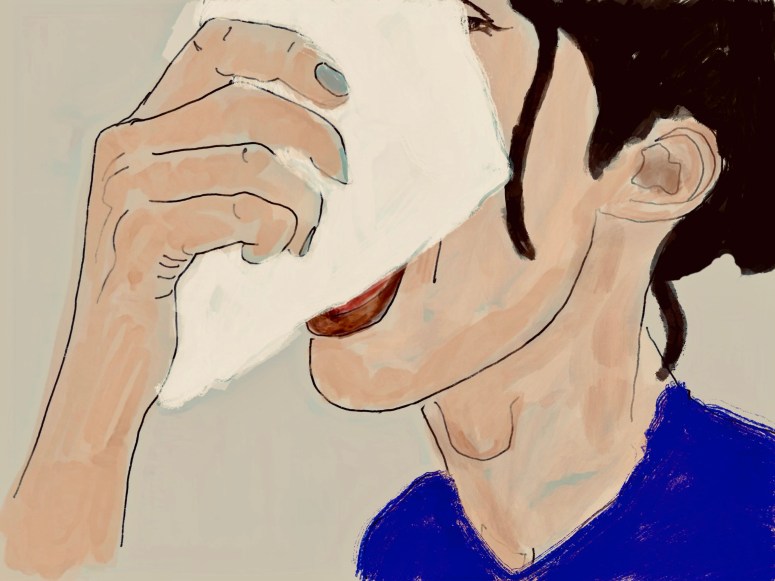 My wife was pissed at me because when she sneezed, I did not say “Bless you!” For context: she was downstairs, I was upstairs. It was the second time in rapid succession that Anna sneezed. The first time she sneezed, very loudly, I did indeed say “Bless you!” projecting my voice to carry downstairs. (Anna is a shockingly loud sneezer. Once when we were on a cruise, she sneezed at breakfast, and everyone in the large dining room stared at us, astonished. Some laughed). A mere thirty seconds later, Anna sneezed again. Given the short time between sneezes, I did not again say “Bless you!”
After a few minutes, Anna came upstairs, allegedly to get a second cup of coffee, but in truth, to glare at me—to fix me with a molten, disapproving look until I glanced up from my spreadsheet and said “What?”
“Why didn’t you say ‘Bless you’?” she demanded.
I pointed out that I had, after the prior sneeze.
She retorted that her second sneeze occurred a long interval later.
I disputed her characterization of thirty seconds as “a long interval.” “If you sneezed five times in a row, would you expect me to say ‘Bless you’ five times? That’s nuts.”
“It wasn’t ‘in a row,’ there was a long pause in between.”
I shook my head at this false characterization.
“It’s common courtesy!” Anna said.
I countered that neither of us were religious.
She wanted to know why that was relevant.
I described the origin of “Bless you.” During the Middle Ages, people believed the soul evacuated the body when someone sneezed, and by quickly saying “Bless you!” a bystander was ricocheting or coaxing the soul back into the body.
My wife said she didn’t need a frigging history lesson. She said she would settle for “Gesundheit,” she wasn’t attached to “Bless you” per se. She reiterated the remark about common courtesy. “So what happens to the people whose souls fly out of their bodies? Are they, like, zombies?” Anna asked.
I could have begun another history lesson/diatribe (choose your term) about how Anna was conflating culturally disparate superstitions (Medieval Christian with Haitian during enslavement). But I knew better than to do so.
Anna said, “Anyway, don’t you care about my soul?”
I could have repeated my prior point about how neither of us were religious, but I refrained. I understood her subterranean question: really, she was asking me if I cared about her. So I said “Of course.” Satisfied, Anna returned downstairs.
Kim Magowan lives in San Francisco and teaches in the English Department of Mills College at Northeastern University. She is the author of the short story collection Don’t Take This the Wrong Way, co-authored with Michelle Ross, forthcoming from EastOver Press; the short story collection How Far I’ve Come (2022), published by Gold Wake Press; the novel The Light Source (2019), published by 7.13 Books; and the short story collection Undoing (2018), which won the 2017 Moon City Press Fiction Award. Her fiction has been published in Colorado Review, The Gettysburg Review, Smokelong Quarterly, Wigleaf, and many other journals. Her stories have been selected for Best Small Fictions and Wigleaf’s Top 50. She is the Editor-in-Chief and Fiction Editor of Pithead Chapel.
 MoonPark Review