
By Mark Crimmins
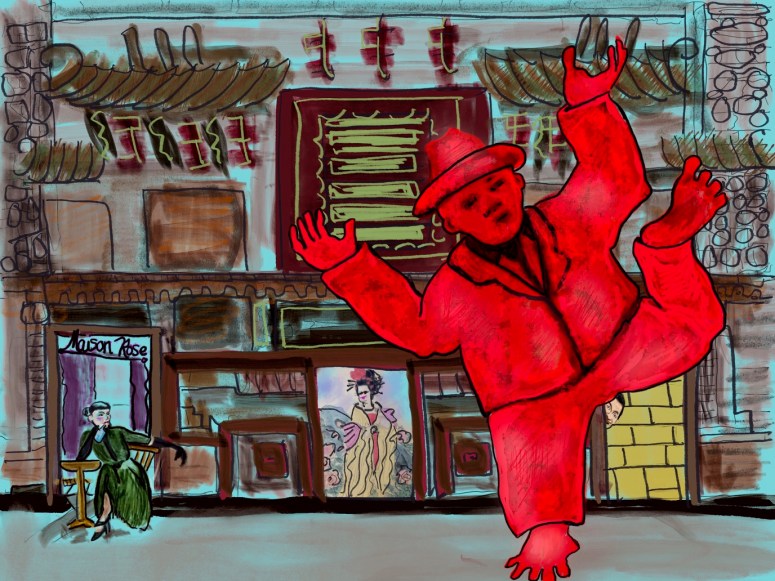
From the windows of Café Ming in Hangzhou, you look across Imperial Song Street at Number 47, a handsome, hundred-and-fifty-year-old cut-stone two-story Qing Dynasty building with three window displays at street level, two of which are actual windows (one revealing Mister Bean peeping out from behind a yellow brick wall; the other containing Audrey Hepburn incongruously contemplating this ancient Chinese street from her terrasse table on a cobbled Parisian thoroughfare), while the third display is a glassed-in doorway sheltering an image of legendary beauty and Tang Dynasty imperial consort Yang Guifei, gloriously enrobed in silk and surrounded by plum blossoms, her ethereal figure a stunning counterpoint in elegance to another figure, from which—discreetly but definitely—she seems to avert her gaze: an enormous modern statue (beside the old building) of an unbelievably fat man wearing a suit and a Panama, stylized elephantiasis rendering his limbs globulate (though he nevertheless dances nimbly on one foot), a red steel giant who towers over the astonished tourists taking snapshots of him with their phones, travellers who are themselves oblivious to the silent lifeless gazes directed their way from that odd trinity of observers (Mister Bean, Audrey Hepburn, Yang Guifei) as well as the gaze that discerns these lines of vision and—consequent to it in the matrix of intersubjective perceptions—the readers who alchemize these words into images at the far end of telescoping time.
Mark Crimmins’s first book, travel memoir Sydneyside Reflections, was published by Everytime Press in 2020. His flash fictions have been published in numerous literary magazines, including Flash Frontier, Pure Slush, Columbia Journal, Portland Review, Atticus Review, Cagibi, Queen’s Quarterly, Long Exposure, FlashFictionNet, Apalachee Review, Reed Magazine, Kyoto Journal, Quarterly Literary Review Singapore, Eastlit, and Flash: The International Short Short Story Magazine. He teaches Contemporary Literature at the Chinese University of Hong Kong Shenzhen.
 MoonPark Review