By Krista Raspor
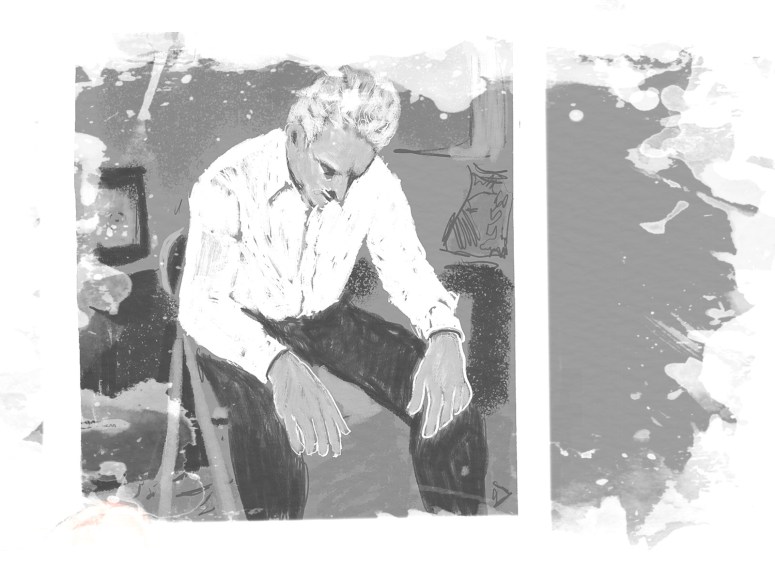
3”x4”, black and white, taken in the late 60s. He’s alone, sitting on a dinged-up folding chair in someone’s living room. He’s wearing a crisp, white, button-down shirt. My Nonno’s closet was full of crisp, white, button-down shirts. Even if he was just going out to buy milk, he got dressed up—jacket, tie, fedora. He held his head high. Kept a steady stride. It was his way of trying to convince the world that he was fine—that he didn’t sometimes slip away.
He always posed for photos. Usually staring at the camera dead on. He wanted the photographer to know he knew he was being watched. But this photo is different. His starched collar crumples under the weight of his hanging head. His shoulders are slouched, his elbows sink into his thighs. His big hands dangle off the edge of his swollen knees.
 I found him in this position once. At my grandparent’s bungalow in the east end of Toronto. It was spring. I was about six. He was hunched over on the front steps, next to the rust-tinged railing, black paint flecking off. Nonna was on the porch behind him, smoking.
“Kako si Nonno?”
“He’s fine,” my grandmother answered for him, her dentures clenched around the filter of her cigarette.
I knew he was not fine. People who are fine don’t sit like that. Maybe he’s sad? Or tired? I thought I could cheer him up. I tiptoed towards him until I was close enough to hear his breathing, laboured and thick with the smell of bitter espresso. I ran my fingers across his forearm, barely touching his skin. “Nonno, why do you always have this number written here?”
My grandmother leaned forward. My grandfather snapped his head up. I stepped back. “Pusti drek da nes smerdit,” his lips barely parted. I looked away, eyes welling. My grandmother rushed down the stairs, her body avoiding his as if by instinct. She grabbed my shoulder and ushered me around the side of the house. At the end of the narrow alley, the chain-link gate shrieked as she pushed it open.
The backyard smelled of young carrot tops and freshly turned top soil. The decades-old sprinkler dripped, keeping the season’s 4/4 time. Nonna sat me down on the sun-warmed bricks of the vegetable garden’s retaining wall. Her polyester pants swooshed as she crouched down in front of me. In a whisper sweetened by cappuccinos and du Maurier Lights, she said, “Pusti drek da nes smerdit.” Don’t be a shit disturber. “Ok,” I agreed, still crying—the number on Nonno’s arm was not something we talked about.
And so we never did. When my grandfather died, he took his Auschwitz tattoo with him. No one living recalls that sequence of digits. He wanted the family to ignore the time from when he was dragged from his home by German soldiers to the time when he came back to his village, hollow and shattered. We played along, kept quiet. But our blind eyes couldn’t erase the ink on his forearm.
I keep that 3”x4” photo in my journal. Whenever I look at it, my eyes, without fail, go searching for the number. Sometimes I use a magnifying glass. Sometimes I use my phone to zoom in. I tilt the photo, bend it, looking for a better angle. But I can’t see the tattoo. It’s not visible. He’s not in the right position. And I know this. I know the photo won’t change. But part of me thinks that maybe one day it will. One day he’ll rotate his arm. Give me the answer. Let me win. But that hasn’t happened yet. He’s still frozen. So I put the photo down and open my laptop. I email Auschwitz. I email the other camps—Dachau. Mauthausen. Gross-Rosen. Can you help me? Do you know? Do you have a record? Did you write it down? Can you tell me the fucking number? “Sorry”. “Documents destroyed”. “Prisoner number unknown”. I go back to the photo often. I run my finger around its edge. I guess I’ll forever be his shit disturber.
Krista Raspor is a creative nonfiction writer living in Toronto. Her essays have been featured/are forthcoming in The Fiddlehead, The Globe and Mail and as part of the CBC First Person series. She writes about living with a disability, travel, and the moments that take on weight when examined closely.
 MoonPark Review