
by daniel joseph
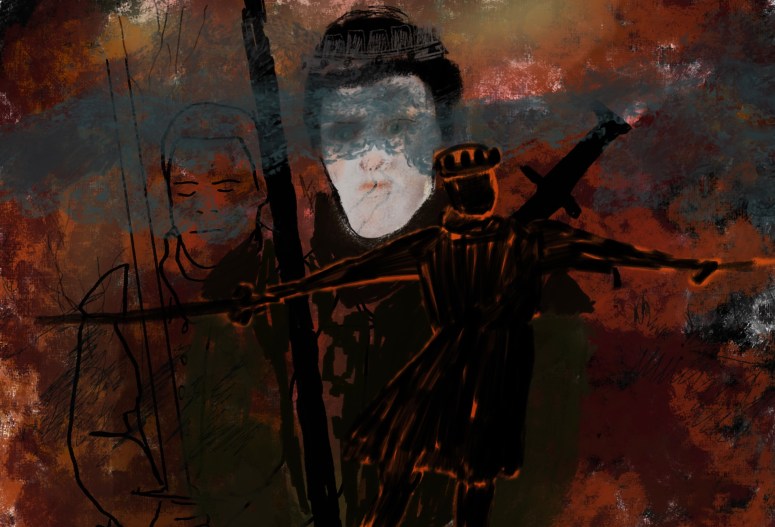
I read Macbeth too much these days. I know. That old horrorshow. But I have my reasons:
- Shakespeare wrote plays decidedly unfit for his characters. I feel decidedly unfit. He tended to write within a genre, but used that genre as an antagonist, famously writing a classic Elizabethan revenge tragedy, but having the revenging son an amateur contemplative. Imagine Hamlet a Trappist monk. Imagine John Wick Hamlet. Easy. But not Shakespearean. Today’s world: Shakespearean as hell for the kind.
- I am drawn to Macbeth because it takes place in a world where we are told “fair is foul and foul is fair” and that the air is “filthy” and that if you “unseem” a traitor “from th’ nave to the chops, / And [fix] his head upon [your] battlements” you are called by a character, whose “virtue” is later favorably compared to that of “a naked-newborne babe,” “valiant cousin, worthy gentlemen.” Seems now.
- For all that has been said of Lady Macbeth, I think she is undersold as a wife, realist, and futurist. She knows her husband. She knows the world. She predicts us. And in Act I, Scene v when she reads Macbeth’s letter about the Wyrd Sisters’ prophecy, her fear is Shakespearean:
Yet do I fear [Macbeth’s] nature;
It is too full o’ th’ milk of human kindness
To catch the nearest way. Thou wouldst be great,
Art not without ambition, but without
The illness should attend it.
She knows that Macbeth lacks “the illness” that must “attend” “ambition” in order to “be great.” Yes. The guy who disemboweled and beheaded the traitor is “too full o’ th’ milk of human kindness” and without “the illness.” Ironic, but we have an inkling of this when Macbeth’s hair “is unfixed” and his heart “knock[s] at [his] ribs” with the “horrid image” of a murdered Duncan being brought to his mind by his immediate ascension to Cawdor. Later, we are reminded of his wellness in his response to Lady Macbeth’s taunt of “coward” for his refusal to kill Duncan: “I dare do all that may become a man. / Who dares do more is none.” What a beautifully muted definition of manhood. In his ante/anti-regicide words, manhood lies not in the excess, but in the restraint. If he were in a different play, if we were a different world, I think people would put that on a coffee mug. Maybe they would stop quoting Polonius. Maybe we would think differently of “what thou art promised.”
- Reading Macbeth kicks me from the curb and into the traffic.
- We seem to have already “jump[ed] the life to come.” Not in the “hereafter” way Macbeth implies, but in the idea of there still being kind-life left to live on this planet, which I’ll admit is very “the-way-to-dusty-death” Macbeth thinking. And I am much more into “we-will-proceed-no-further” Macbeth thinking. But it seems that the value of “great[ness]” is now universal and unimpeachable. It also seems Lady Macbeth’s equation that “illness” and “ambition” are both equally needed for “great[ness]” is just as universal and unimpeachable. And so is the want of most everyone to “catch the nearest way” to this ill-gotten “great[ness].” Lots of people seem more than ok with this gospel. But I fear they are without Lady Macbeth’s honesty: this only comes from being “fill[ed] from crown to the toe-top–full / of direst cruelty.” In fact, it’s getting harder to find corners of the world not full of people repeating this “tale / told by an idiot, full of sound and fury” as if it signifies something great, good, and inevitable.
- But “[Macbeth] doth [not] murder [my] sleep.” No. I read and read Macbeth to stay woke to the mass of folks in our world running in the other direction. The folks who have not “stop[ed] up th’ access and passage to remorse” and who have seen the “wound” the “keen knife” makes and are running to help the bleeding. And I see in their cast a Macbeth restaged in which Macbeth “does no more,” and in so (not) doing, fights against the ethos of greatness, against the reteaching of “bloody instructions, which, being taught, return to plague th’ inventor;” a Macbeth that ends not in chic nihilism but tragically and unsatisfyingly in the kindness of “double trust:” heroic Macbeth stunted by his wellness; us wonderfully content with “lesser than Macbeth…
daniel joseph writes in a fertile river valley. his most recent work can be found or is forthcoming in Bruiser, The Heavy Feather Review, Frigg, Trampoline, Passages North, Biscuit Hill, HAD, and X-R-A-Y.

