By Jeff Radwell
The city posted notice fourteen days before, which was the law, and Geri had read it taped to the chain-link on her way to the bus and thought: fourteen days. That was a Tuesday. By the following Tuesday she had stopped thinking about it.
The morning it happened she was walking her usual route because her bus came at 7:42 and the stop was on that block and there was no other way to get to work that didn’t add twenty minutes, which she didn’t have. She had her headphones in. She took them out.
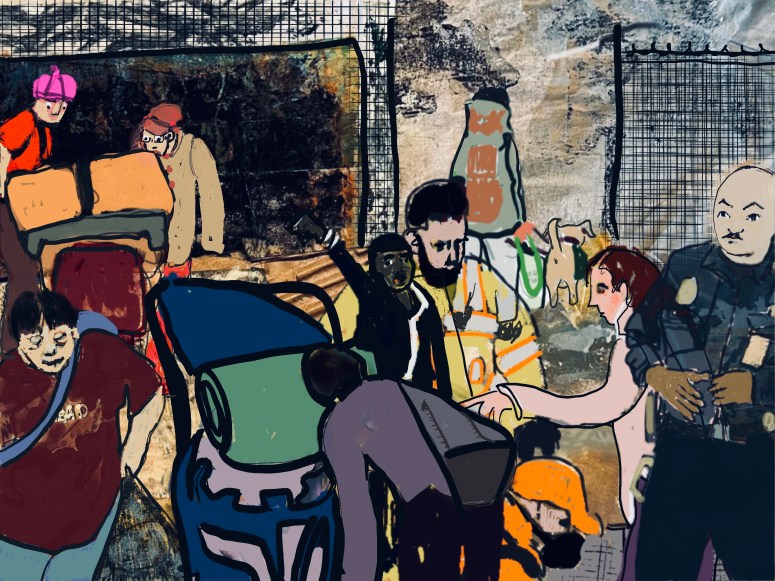 There were six of them in yellow vests. A SANITATION truck and one she didn’t recognize, white, with no markings. A police cruiser parked with its wheels on the curb but no lights. The officer leaned against it looking at his phone. The whole encampment was about forty feet across, maybe twelve people’s worth of living arranged under the 110 in an order that she now understood, seeing it about to be unmade, had been an order — zones and paths and an understanding of shared space that she hadn’t recognized as such when she’d walked past it every morning for two years.
One man was arguing with a vest. Not loudly. The careful disagreement of someone who’s learned that loud gets your teeth slammed into pavement. The vest held a clipboard and nodded while he talked and when he stopped nodded again and pointed at the white truck. The man turned and looked at the truck and his shoulders did something and he stopped arguing.
A woman was already packing. She had a system. She broke it down. Photographs off the tent wall first, Geri could see them from the sidewalk, faces in plastic sleeves, then the bedding, then the tent poles, everything going into a rolling suitcase that was missing one wheel so it dragged leaving a trail of plastic scuffs. An older man sat on an upturned bucket and watched and did not pack, and no one made him.
The things that weren’t claimed went into black bags. A vest moved quickly through what was left, latex-gloved hands lifting a lamp with no cord, a coffee can of pencils, a child’s drawing weighted down with a rock because someone had put it there. Someone had chosen to display it in that place, that home. Into the bag.
The 81 bus came at 7:42. It was 7:39.
She thought about the fourteen days, how they’d moved through those days and slept in them and woken up in them and maybe told each other it wasn’t going to happen, or maybe didn’t speak of it at all, the way you don’t say certain things out loud because saying them gives them a body. She thought about how she had read the notice and thought fourteen days and then gotten on her bus.
7:41. The woman with the suitcase had moved to the sidewalk and was standing twenty feet from Geri waiting, it seemed, for the same bus. She had the suitcase and a backpack and a tote bag hanging from each hand. She was maybe fifty. She was looking down the street the way everyone looks for a bus.
Geri could not think of a single thing to say that wasn’t, at its root, about herself. She thought of six or seven things. They were all about herself.
The bus came. They got on separately and paid separately and the woman moved to the back and Geri stood near the front and they rode downtown together and did not speak and at some point Geri looked back and the woman was gone, some stop she hadn’t tracked, and outside the window Los Angeles was doing what it does every morning, which is act like it has always looked exactly like this.
Jeff Radwell has work featured or forthcoming in Oxford Magazine, Foglifter, Hobart, and elsewhere. Radwell is the 2026-28 literary fellow of the California Arts Council for Los Angeles. Find him at www.jeffradwell.com

