
By Garima Chhikara
Where were you last night? I wait for him to ask me the question, but he doesn’t. Why would he when I had explicitly told him not to bother with where I’d been, not to suffocate me with his neediness?
The whirring of the coffee machine and his soft humming of a song that later stuck in my head don’t drown out my restlessness.
Jay finds making coffee meditative. So is obsessing over conspiracy theories—whether Subash Chandra Bose is still alive, living as a sadhu in the mountains, or whether chips are planted in our root canals to track us, make us sick. They aren’t rumours to him. They are the closest thing he has to believing something could still be uncovered.
I wish I had something like that, too. But everything I touch feels temporary. Even the things I once enjoyed—big breakfasts, opinions, warming my feet against his chest—lose their shape the moment I reach for them.
Now, all of it exhausted me. Everything felt staged: this living room, the silence between us, Jay with his unbothered steadiness.
“Do you want to talk about it?” he says, sitting opposite me, sipping coffee and scrolling on his phone.
I shrug without even asking what he meant.
“There are black holes everywhere,” I say. “Manholes marked with symbols, sealed with cement, and railings. The kind that lead straight down.”
He looks up, “What?”
“It’s a theory. Some who fall into it do not come back; those who do aren’t the same.”
“And, who created these holes?”
“That’s not important. The government, probably. Some leftover nuclear experiment or something,”
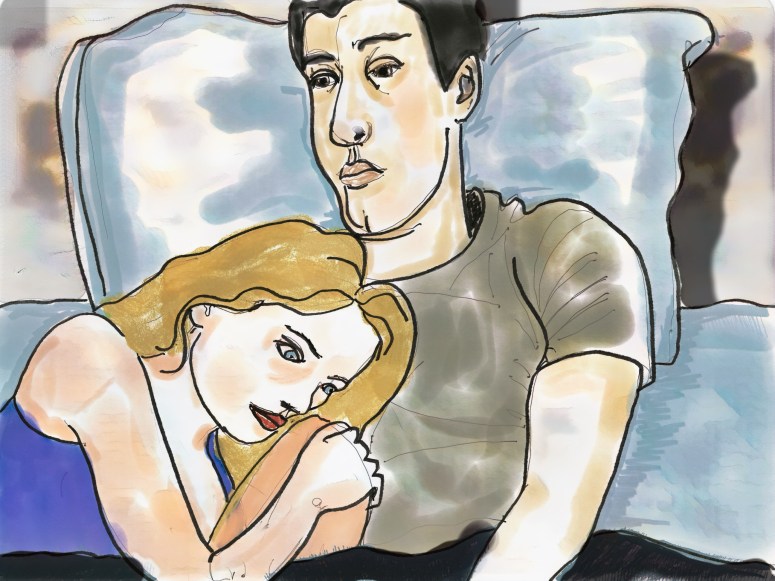 He looks at me carefully; there’s no curiosity in his gaze, only concern. It’s how he looks at me lately. Even at night, when his arm is around my back, and my face is pressed to his chest, I bury my desperation there and tell him he could do anything to me. He doesn’t shift or say a word.
“People who come back get polluted somehow. Their wants and desires come out. They can’t avoid it. Like those people yelling their truths on the street, or quitting their jobs all of a sudden to do something else.”
He says nothing.
“Don’t you want to know where I was last night?”
“What are we doing here? You want me to comfort you without telling me what happened?”
I leave, smashing the bedroom door behind me.
I wanted to tell him I was in the black hole, amidst the dirty, thick smoke of temporary touch and conversations that went nowhere.
But I wasn’t in a black hole, or anywhere worth mentioning. When everything feels unmoored, it’s comforting to imagine you still have access to some other version of your life, even if it only exists in your head.
At dinner, he tells me he’ll be away for a while. I don’t ask where he’s going, even though every part of me wants to. It’s only fair that way.
Garima Chhikara is a writer from Bangalore, India. Her work appears or is forthcoming in Forge Literary Magazine, Hypertext Magazine, Hobart, Cherry Tree, Carte Blanche, and elsewhere, and has been nominated for the Pushcart Prize. Find her at garimachhikara.com.

